
- Guide
- Flavors
As the summer fishing moratorium formally ends, fishing boats cut through the waves heading out to sea. When the first fleet returns to harbour with full holds, balang, squid, hairtail and three-spot crab appear in seafood markets.
Among all seafood landings, the balang (blue mackerel scad, Decapterus maruadsi) cuts an unassuming figure. It rarely features on banquet menus, yet it has been one of the earliest and most reliable seasonal catches for centuries. Eaten in Quanzhou since the Ming dynasty (1368‑1644), this fish has long woven itself into local everyday life.
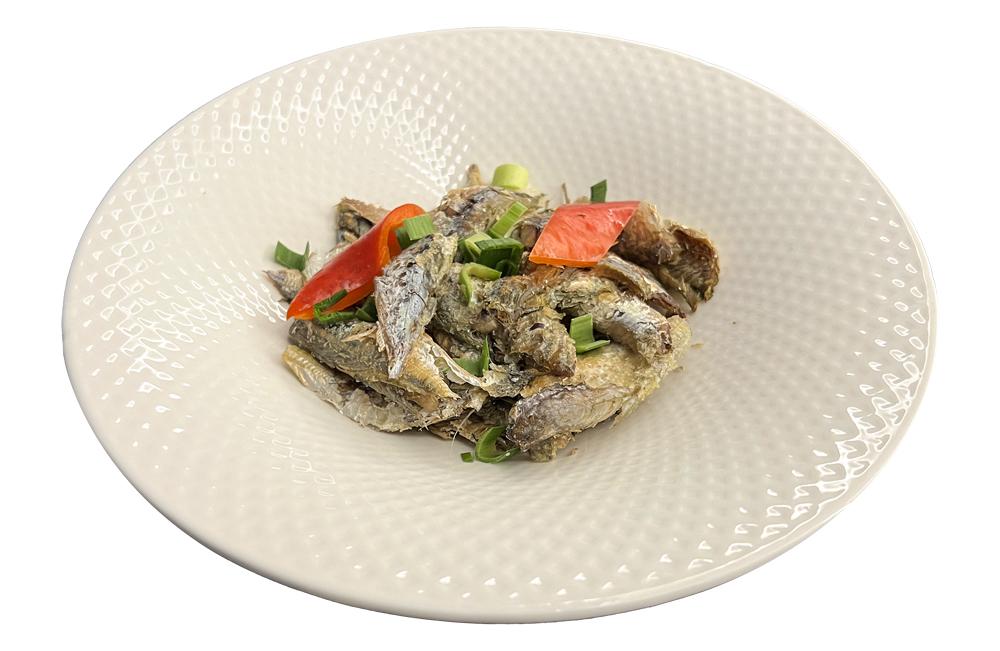
Dried balang. (Quanzhou Evening News file photo)
'Rice and fish soup' in the old gazetteers
The Quanzhou Prefecture Gazetteer captures ancient Quanzhou’s harsh living conditions in a few concise lines: ‘The territory is cramped and its produce poor. Silkworms fill no baskets, and the fields yield too little for tillage. Rice, beans, wheat, silk thread and wadding have always been brought in from Wu and Zhe; only the yield of fish, shrimp, snails and clams is relatively plentiful.’With its hilly terrain and limited infertile farmland, Quanzhou relied on outside regions for grain and textiles; livestock meat was especially scarce. Only the twice‑daily tides delivered abundant in-shore seafood, a vital resource sustaining local ancestors. The gazetteer further notes: ‘The people take delight in rice served with fish soup and do not dare to covet meat.’ For ordinary residents in old times, a bowl of rice paired with sea‑fish brought contentment, with no expectation of rich delicacies.Late-Ming Minnan historian He Qiaoyuan wrote in his Book of Min that Quanzhou ‘leans against hills and faces the sea’, where ‘fish, shrimp, snails and clams outnumber grain cooked in pots’. Such geographical conditions fostered the enduring Minnan custom of eating fish as everyday vegetable‑style fare.
Along the southern Fujian coast there runs a fishermen's rhyme ranking the 'twelve fine fish': 'First, the wu; second, the red sha; third, pomfret; fourth, Spanish mackerel; fifth, the mian croaker; sixth, jiala; seventh, small squid; eighth, cuttlefish; ninth, lizardfish, praised by all; tenth, the guitarfish; eleventh, the croaking red gua; twelfth, lobster and hairtail.' Every fish on the list is a good fish in southern Fujian eyes. The balang is not among them. Yet it is precisely this fish, too plain for the 'freshness list', that best fits the needs of the local people - and it has become Quanzhou's most representative everyday seafood.
In the Ming dynasty, 'one netful worth hundreds of taels of silver'
The balang has inherent limitations. It dies the moment it leaves the water and does not travel or keep well; its coarse flesh means it seldom appears at formal banquets. Yet who would think that in the Ming dynasty it was once a costly seafood delicacy? Hu Shi'an, in the Extra Collection of his Illustrated Eulogies of Unusual Fish, calls the fish 'bolang' and records that 'in the fifth and sixth months it comes in great shoals, and a large netful could sell for hundreds of taels of silver'. There was no refrigeration then, and since the fish dies on leaving the water, only freshly landed catch fetched a price - and that price was steep. Ordinary people rarely got to taste it.
The turning point came in the mid-twentieth century. In 1964, light-purse-seine fishing was successfully trialled and rolled out along the Fujian coast, and Quanzhou's fishery entered an era of intensive harvesting. Large-scale catches of balang became possible. At the same time traditional species collapsed: large and small yellow croaker, hairtail and cuttlefish declined sharply under heavy overfishing, while the highly fecund balang seized the space left behind and rose to become a 'dominant stock'. According to the 1929 southern Fujian fishery statistics cited by Zhu Jialin in his Notes on Eating the Sea, the balang was then still counted among the 'minor miscellaneous fish', in a different league from the leading species such as hairtail, large yellow croaker and pomfret. But by 1989, in Hui'an - once China's top county for hairtail landings - balang already accounted for a third of the county's total catch, twice the figure for hairtail.
The surge in supply pushed the price right down. Cheap as green vegetables and within reach of every household, it became a taste on Quanzhou tables in every season.
A practical philosophy of wasting nothing
Cheap and easy to get as it is, Quanzhou people have never treated the balang carelessly. Coastal households understand the nature of their ingredients well, and following the fish as it moves from fresh to cured, they have worked out a way of eating that uses every stage and wastes none of its flavour.
Straight off the boat and still lively, the whole tray is steamed and arranged on a bamboo winnowing basket. The silver-blue bodies glisten, the flesh is firm with a clean, sweet flavour, and a few drops of light soy sauce are all it needs - the simplest of old-fashioned tastes. A southern Fujian seasonal rhyme says: 'In the fourth lunar month the balang has no scales' - meaning that April balang is at its fattest, needing no elaborate cooking, just one bite of honest freshness.
Balang of slightly diminished freshness, kept overnight, with a little of its freshness gone, is pan-fried. Slowly fried in lard until both sides are crisp, the fat seals the savour into the flesh - coarse-textured and satisfyingly chewy. An old southern Fujian saying has it: 'Balang fried in lard is so good you will not share it with your own husband' - and that is exactly this everyday dish.
Half-dried fish, neither fresh nor cured, goes into sweet-potato starch dumplings. Flaked balang flesh is mixed with sweet-potato starch, streaky pork, cauliflower and peanuts, rolled into balls and boiled until they float. This dish comes from hard times, when cheap ingredients were combined simply to fill a stomach; but the salty savour of the balang has made it an old-fashioned taste passed down through generations.
What cannot be eaten is sun-dried. Once freshness has run its course, the fish is handed over to the sea wind and the sun. Fishermen steam the balang, spread it out to dry, and let the fierce sun and salt air draw out its moisture. The Records of the Marine Products of Southern Quanzhou note that after light-purse-seine fishing was introduced in the 1960s, 'the catch of balang and sardines was especially large ... they were being dried all along the southern Fujian coast, particularly on the rocky hillsides of Shenhu, which were covered with them, and the air was full of the smell of drying balang.' This local custom is informally called 'autumn sun-drying' (not restricted to autumn). Dried, the flesh is 'firm and crisp, remarkably sweet, and especially satisfying to chew'.
Steamed, pan-fried, made into dumplings or sun-dried: the whole practical logic of Quanzhou life - following nature and wasting nothing - is hidden in these ways of cooking.
The hidden 'note of freshness' in everyday food
Once dried, the balang enters the Quanzhou diet in another way.
The stock for mianxianhu - fine wheat vermicelli in a thickened broth - is often simmered with dried balang. The fish hides in the soup without a trace, yet it gives the whole bowl its soul. Add a little dried balang to rice-noodle soup and the stock gains real body. The Records of the Marine Products of Southern Quanzhou records: 'When fishing families entertain relatives and friends, they boil a bowl of rice-noodle soup with dried balang flesh and scatter spring onion on top; the taste lingers long after.'
Then there is southern Fujian savoury rice. Radish savoury rice, cabbage savoury rice - without a little dried balang they lose their rich, sweet-savoury depth.
From vermicelli broth and rice-noodle soup to savoury rice, dried balang is everywhere. It is no longer simply a dish; it has become the underlying note that lifts flavour throughout the southern Fujian palate. Many visitors tasting mianxianhu for the first time find the stock delicious without being able to say where the savour comes from. Once you know the secret and taste again, there is an extra sweetness on the finish.
In 2016, 'Shenhu dried balang' was registered as a national geographical indication(GI) trademark. A fish that once could not appear on a proper table now has a name of its own, and has become a vivid calling card for Quanzhou's maritime food culture.
Through centuries of tides, the balang has kept its place on Quanzhou tables. It is not the most expensive fish, but it is the most 'Quanzhou'. It is not precious, yet it is missed if two or three days go by; not rare, yet it has been cooked in endless variations for hundreds of years; never the star, yet hidden in the stock of vermicelli broth, in the steam of savoury rice, in the filling of starch dumplings. It can lead or support, takes what the season gives, stays plain and ordinary - and always does the job. That temperament is very like the Quanzhou character: rooted in the ordinary, standing firm in the everyday, never showy or boastful, yet always able to make plain days taste good. For visitors, eating a balang in Quanzhou is the most direct way to feel this attitude to life.
Taste a home flavour centuries old
Come to Quanzhou for balang during the fishing season: follow these three pointers for where and how to eat it, and you will not go far wrong.
To feel the dockside bustle of boats unloading, go to Xiangzhi in Shishi or Shenhu in Jinjiang. The seafood restaurants by the harbour cook nothing but freshly landed catch; a plate of it steamed is the home taste coastal families have eaten for centuries.
To eat as you stroll, head for Xunpu Fishermen's Wharf in Fengze district. Pick your just-landed seafood at the market by the quay, hand it to the open-air food stalls next door - they will steam it or fry it with salt and pepper - then wander the night market and listen to the live bands.
If you want to take some home, fishing families around the harbours of Shenhu and Xiangzhi sun-dry their own balang. Buy a pack, tear a few pieces into your noodles or vermicelli at home, and the savour of Quanzhou comes home with you. (By He Jiamei)
 Return List