
- Updates
- News
Source: 16 July 2026, evening. Quanzhou Maritime Silk Road Boya International Hotel.
On the evening of 16 July 2026, a dialogue of flavours bridging mountains and seas was held to great success at the Quanzhou Maritime Silk Road Boya International Hotel. Four master chefs of Fujian cuisine and leading figures of the catering industry from Quanzhou, Fuzhou and Xiamen gathered on the same stage for the first time in the live-streaming programme "Quanzhou Cuisine · Master Talk".

Live-streaming scene of "Quanzhou Cuisine · Master Talk"
This was no ordinary culinary exchange. In the first year of building on Quanzhou's designation as a UNESCO "City of Gastronomy", this special live stream, themed "One Taste of Mountain and Sea, the Harmonious Resonance of Min", sought to answer a bigger question: now that Fujian cuisine has stepped onto the world stage, how can the three cities each display their own brilliance while resonating in harmony?
From Fuzhou's benchmark effect, to Quanzhou's cultural effect, and to Xiamen's window effect — the cuisines of the three cities share the same roots and origins, yet each possesses its own character. This live stream was a collective statement of the aspiration that Fujian cuisine should move from the local to the world stage.
Four accounts recalling the "golden years" of Fujian cuisine
The four guests in the live stream were: Cheng Zhenfang, a founding-generation certified Chinese master chef and honoured master of the Chinese Culinary Masters' Hall of Fame; Luo Shiwei, a senior certified Chinese master chef and representative inheritor of the national intangible cultural heritage craft of Ju Chun Yuan's Buddha Jumps Over the Wall; Luo Bingfu, a senior certified Chinese master chef and executive vice-president of the Xiamen Culinary Association; and Chen Rixing, president of the Quanzhou Association of Celebrated Chefs and expert adviser to Quanzhou's bid for the UNESCO "City of Gastronomy".
Among the four guests' accounts, four episodes stood out as particularly memorable, sketching the "golden years" of Fujian cuisine over the past sixty years.
Cheng Zhenfang recalled that in the 1970s, a state-owned catering enterprise in Quanzhou won a commendation from the State Council and was rated an advanced unit in the national commercial system. "At that time it was the only one in Fujian Province — a source of pride for Quanzhou's catering industry."
Luo Shiwei traced back to the 1980s, when Buddha Jumps Over the Wall entered the state banquet served to the President of the United States; the traditional ceremony of unsealing the pot had to be adapted to diplomatic etiquette, giving birth to the individually served "Buddha Jumps Over the Wall" (即位佛跳墙).
Luo Bingfu mentioned that as early as the 1990s, a Xiamen catering enterprise had opened a restaurant in Singapore — an early mark of Fujian cuisine's journey abroad.
Chen Rixing spoke of how, in the 1990s, he began with his first taste of Buddha Jumps Over the Wall at Ju Chun Yuan on Dongjiekou in Fuzhou, moved on to survey the catering markets around Lianban and Jiangtou in Xiamen, and finally put down roots in Quanzhou, participating in and witnessing all along the vigorous development of the cuisines of the three cities. The past is as vivid as yesterday: a personal career history interwoven with, mutually corroborating and inseparable from the culinary history of the region.
Same and different: three cities, each with its own character, under the single character "Min"
Fujian cuisine is one of China's eight great culinary traditions, yet beneath the single character "Min" (闽), the flavours are manifold.
Cheng Zhenfang summed up the essence of Quanzhou cuisine in eight characters: "The intermingling of mountain and sea, the coexistence of diversity" (山海交融,多元共生). In his view, Quanzhou leans on the mountains and faces the sea, its ingredients drawing on both, and its flavours pursue "clean, fragrant, refreshing and fresh". More importantly, as the "Museum of the World's Religions", Quanzhou's food culture is a great fusion of Central Plains, Minyue, maritime and foreign cultures — the beef-eating custom came from Arabia, satay noodles originate from the Nanyang "satay", and misua soup cannot do without the "imported" white pepper. "Quanzhou cuisine is a living vessel of 'one taste shared by mountain and sea, one banquet gathering past and present'," he concluded.
Fuzhou cuisine, by contrast, has taken a different path. Luo Shiwei pointed out that Fuzhou and Quanzhou cuisines both belong to Fujian cuisine and both value soup-making, fine knife work and skill in cooking seafood. Quanzhou cuisine is clear, fresh and elegant, adept in the use of compounded spices and marked by a distinctive fusion of Chinese and Western elements. Fuzhou cuisine, on the other hand, favours sweet-and-sour tastes, makes good use of distinctive seasonings such as red yeast rice and fermented shrimp sauce, and offers endless variation in its soups: "Buddha Jumps Over the Wall, the king of Fujian cuisine, is rich and mellow; chicken soup with fresh sea clams, the queen of Fujian cuisine, is clear in broth and fresh in taste — these two soups represent the highest realm of soup-making in Fujian cuisine."
Xiamen cuisine excels in openness and inclusiveness. Luo Bingfu believes that Xiamen and Quanzhou belong to the same Minnan culinary family, but that, owing to its character as a tourist city, Xiamen has naturally developed an eclectic style: "Xiamen cuisine has always been grounded in traditional techniques and oriented towards the aesthetics of the times and the demands of the market."
Chen Rixing then offered a summary from the angle of the three cities' "irreplaceability": "Buddha Jumps Over the Wall is the king of Fujian cuisine, with an unrivalled benchmark effect; Quanzhou possesses the unique cultural IP of World Heritage and the Maritime Silk Road; and Xiamen plays the role of an international window with the capacity for innovation and absorption."
Upholding tradition and innovating: the future needs more "compound talents"
How can traditional Fujian cuisine innovate while upholding tradition? This was the most intense intellectual collision of the live stream.
Taking Buddha Jumps Over the Wall as an example, Luo Shiwei shared three dimensions of innovation: the form of serving changed from the large pot to individually served portions; high-cholesterol ingredients were replaced with morel mushrooms and king oyster mushrooms; and a half-portion version of Buddha Jumps Over the Wall was introduced. But he stressed the bottom line — "the intangible-heritage craftsmanship absolutely cannot change".
Luo Bingfu, from the perspective of culinary education, put forward the proposition of "learning the rationale of dishes" (学菜理). "The culinary profession spans a broader range of knowledge than any other specialism — politics, economics, physics, chemistry and art are all involved. When I teach apprentices, I emphasise strongly that they must understand why a dish is made one way and not another, and deepen their understanding of the Maillard reaction, caramelisation, ageing and other culinary principles." He believes that the "newness" of the New Fujian Cuisine lies in new techniques (such as low-temperature slow cooking (sous-vide)), new presentation (the balance between flavour and aesthetics) and new transmission (the aesthetic and innovative awareness of young chefs).
Cheng Zhenfang focused on talent development. He shared that Quanzhou has built a full-chain system of "school education + social cultivation + master mentoring", and he noted in particular that "the future calls for cross-disciplinary talents who understand not only culinary skills but also culture, management and digitalisation".
Looking ahead: a call for the three cities' Fujian cuisines to go global together
At the end of the live stream, the conversation returned to "going out".
Chen Rixing revealed that, after Quanzhou was named a UNESCO "City of Gastronomy", he led his team on visits to Europe and, within China, frequently visited sister cities such as Chaozhou and Shunde; not long ago he also led a team to join the "Set Sail" initiative launched by China's seven Cities of Gastronomy. "Wherever an event is held in the future, the other Cities of Gastronomy will participate and give their support."
He called on Quanzhou, Fuzhou and Xiamen to unite, and, when the time is ripe, to plan a collective overseas voyage of the New Fujian Cuisine and jointly stage events abroad. "Because the honour of being a City of Gastronomy belongs to Fujian Province, and we should work together."
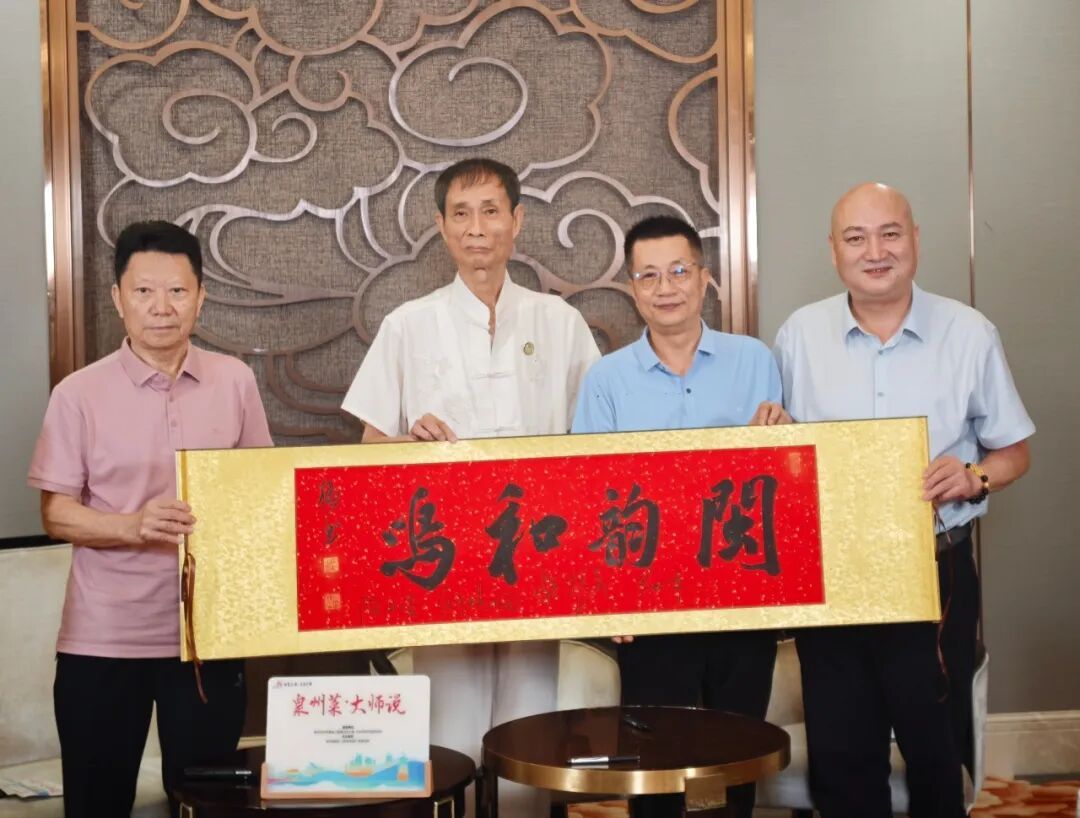
The four guests issued their "Master Declarations"
In the context of jointly discussing the path for Fujian cuisine to go global, and around the key phrase "the Harmonious Resonance of Min", the four guests issued their respective "Master Declarations" at the end of the live stream:
Cheng Zhenfang: "Mountain and sea in fusion brew new flavours; uphold tradition and innovate to cook the future. May the New Fujian Cuisine, in the harmony of tradition and trend, spread its fragrance across the four seas and move the world's palates."
Luo Shiwei: "Intangible-heritage cuisine, shared by the whole world."
Luo Bingfu: "Uphold tradition, transmit the new; Fujian flavours sail far afield."
Chen Rixing: "Three cities, one lineage, carried by a single ladle; mountain and sea in harmony, heard across the world."
 Return List