
- Updates
- News
Quanzhou Net, 2 November — (Reporter Qiu Feng; correspondents Ye Guanqing, Chen Xiang and Lei Yingmiao, text/photos) On the afternoon of 31 October, a key component of the 2026 Quanzhou International Gastronomy Month — the UNESCO-LEE KUM KEE "Forever Flavors" Young Culinary Heritage Practitioners Capacity Building Programme (Quanzhou) theme event — was held at the Quanzhou Honor International Hotel.
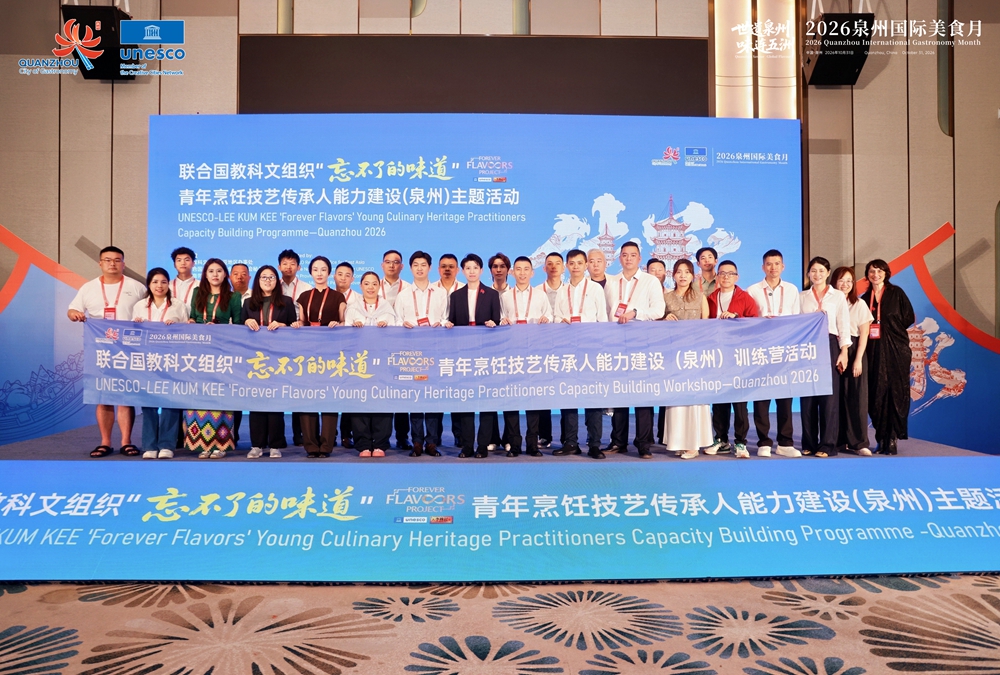
At the event
At the ceremony, Duong Bich Hanh, Head of the Culture Unit at the UNESCO Office for East Asia, gave a systematic introduction to the "Forever Flavors" project. She noted that the project aims to safeguard culinary traditions as living heritage and to preserve the shared taste memories of the public. By collecting "flavour stories," advancing digital storytelling and building networks, the project connects bearers of food heritage with emerging young professionals and fosters community-based, healthy innovation. She pointed out that food-related intangible cultural heritage is not static but is constantly recreated in everyday kitchens, and expressed the hope that, through youth capacity building, the culinary memories carrying emotion and culture will be passed down from generation to generation.
In the thematic-sharing session, Dodie Hung, Executive Vice President of Corporate Affairs at Lee Kum Kee Sauces, spoke on "A Century of Craftsmanship and Taste Memories," explaining how food sustains family bonds and forges collective identity. A short film by young chef Zheng Yongqi was screened on site; through the taste of spring rolls from his memory, he illustrated the intergenerational transmission of culinary skill and family affection.
In the case-sharing session, Ahmed Eiweida, Senior Investment Officer at the Asian Infrastructure Investment Bank, compared the commonalities between the food cultures of Quanzhou and Egypt and explained the value of the creative food industry in driving local development; Fang Fei, an Italian sinologist and researcher of fermentation and food culture, shared findings from field research on fermentation culture across several regions of China; and Xu Xiaochun, expert consultant for Quanzhou's bid for the title of "City of Gastronomy," used the "Shijing Shizhou Banquet" and the "Song-Yuan Maritime Silk Routes Banquet" as examples to introduce the revitalised innovation of Quanzhou's traditional flavours in contemporary banquets.
At the event, the Young Culinary Heritage Practitioners Capacity Building Workshop (Quanzhou) was launched. It is understood that the workshop will last five days and include intensive lectures, field research, intangible-heritage experience, and hands-on culinary competitions. Participants will visit the old city's food markets, intangible-heritage venues, ingredient origins and industry bases, complete a creative Quanzhou-cuisine creation, and present their work at a closing sharing session.
 Return List